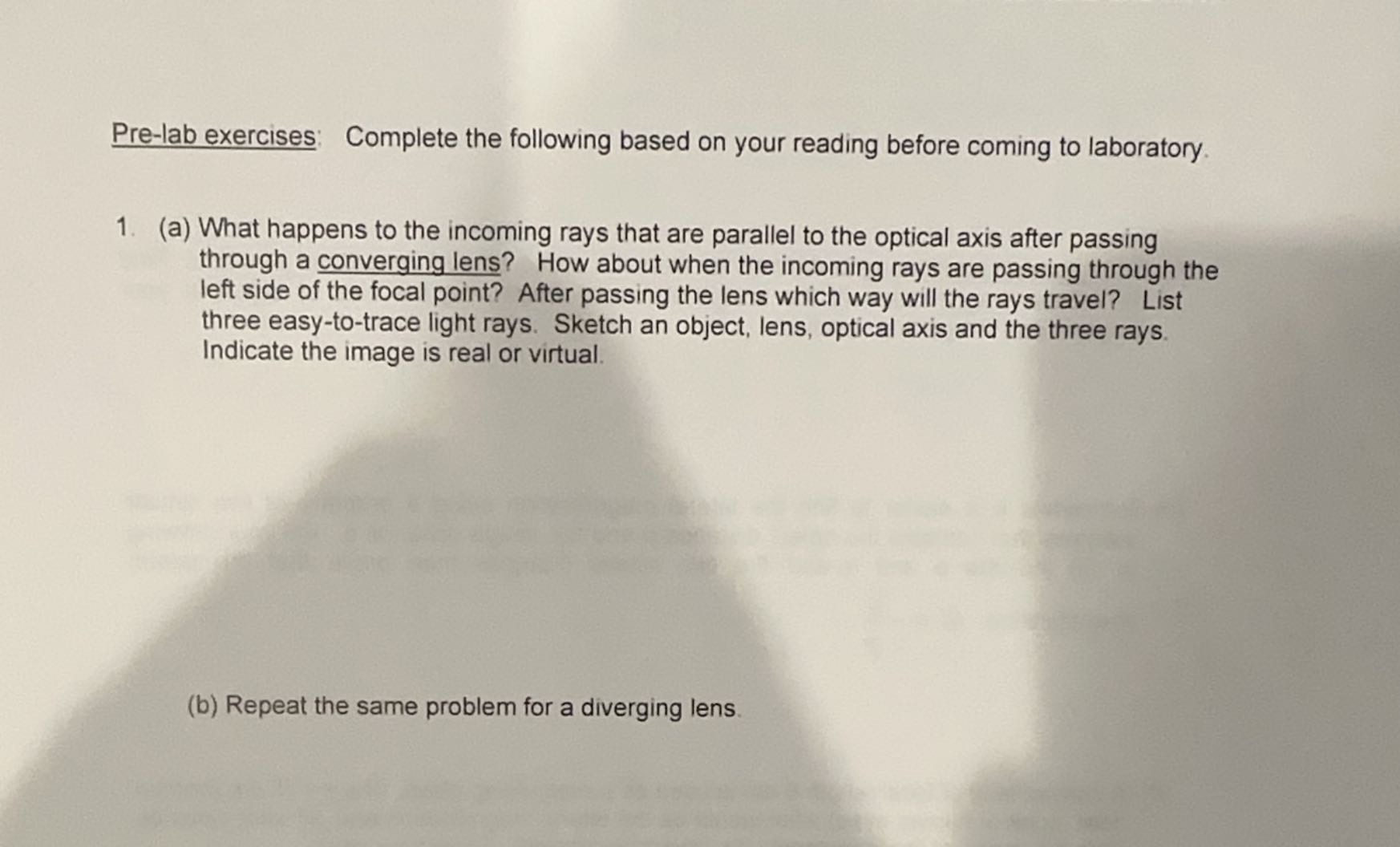
Pre-lab exercises: Complete the following based on your reading before coming to laboratory. 1. (a) What happens to the incoming rays that are parallel to the optical axis after passing through a converging lens? How about when the incoming rays are passing through the left side of the focal point? After passing the lens which way will the rays travel? List three easy-to-trace light rays. Sketch an object, lens, optical axis and the three rays. Indicate the image is real or virtual. (b) Repeat the same problem for a diverging lens.
Asked by an UpStudy premium member to our live tutor.
Real Tutor Solution
Answer

Solution
(a)
What happens to incoming rays parallel to the optical axis?
They refract through the lens and pass through the focal point (F) on the opposite (right) side of the lens.
What happens when incoming rays pass through the left-side focal point?
After passing through the lens, they refract and travel parallel to the optical axis.
The three easy-to-trace light rays (Principal Rays):
Ray 1 (P-ray): Parallel to the axis, goes through the far focal point.
Ray 2 (M-ray or C-ray): Goes straight through the center of the lens without bending.
Ray 3 (F-ray): Goes through the near focal point, comes out parallel to the axis.
Image type: For an object placed beyond the focal point (as shown in the sketch), the image is Real (it forms where light rays actually intersect).
Sketch:
Here is a standard ray diagram showing an arrow object, a converging (convex) lens, and the image formed.

(b)
What happens to incoming rays parallel to the optical axis?
They refract through the lens and diverge. If traced backward (dashed lines), they appear to originate from the focal point (F) on the same (left) side of the lens.
What happens when incoming rays are directed towards the far focal point (on the right)?
After passing through the lens, they refract and travel parallel to the optical axis.
The three easy-to-trace light rays (Principal Rays):
Ray 1 (P-ray): Parallel to the axis, diverges as if coming from the near focal point.
Ray 2 (M-ray or C-ray): Goes straight through the center of the lens without bending.
Ray 3 (F-ray): Directed towards the far focal point, it comes out parallel to the axis.
Image type: A diverging lens always forms a Virtual image for a real object (formed by tracing diverging rays backward). It is upright and smaller.
Reviewed and approved by the UpStudy tutoring team
 Explain
  Simplify this solution